
Where the petrol price comes from
Of every £100 you pay for petrol in the UK, £53 covers the fuel, its transport and the station's margin, and £47 is tax. Data for the week of 26 October 2026.

The essentials
- The price follows oil, the dollar and refining costs. That's why it changes every week.
- 47% of the price is tax (fuel duty and VAT); the rest is fuel, transport and margin.
- Fuel duty is a fixed amount per litre, and VAT is charged on top of it.
One litre of petrol, from the inside
We start with the price on the sign and peel off the layers. Tax first. Then we see what's left.
- Crude oil (Brent)
- Refinery
- Lorries and depots
- Station
The data only says how much is left in total. It doesn't split it across these four steps.
Data for the week of 26 October 2026.
How much of your fill-up is tax?
Enter what you spend filling the tank. You'll see where each part goes, using data for the week of 26 October 2026.
How it's built, step by step
It all starts with a barrel of oil
The oil that sets the price in Europe is called Brent. A barrel is about 159 litres and is paid for in dollars. If oil rises, petrol tends to rise. If the dollar gets stronger against the pound, the barrel costs more pounds too. And that happens even if oil itself doesn't move.
The refinery turns it into petrol
Crude oil can't go in a car as it is. A refinery turns it into petrol, diesel and other products. That step is called refining. Refined petrol and diesel are sold to stations at their own price, which depends on what refining costs and how much demand there is. That's why petrol doesn't move exactly like oil.
Lorries, depots and the station: what changes from one to the next
Then the fuel has to get to the station. That costs transport, storage and staff. Each station also adds its margin: what it charges over what the fuel cost it. Each one decides its own. That's why two stations close together can charge different prices on the same day. This part has no figure of its own: the data only gives the total of what's left before tax.
Then the tax: 47% of the price
Two taxes are added. The first is fuel duty, a fixed amount per litre: 52.9 p/L in the week of 26 October 2026. It doesn't change when oil goes up or down. The second is VAT, 20% on everything before it, duty included. Together they make up 47% of the price of petrol and 43% of diesel.
And that's how it gets to the sign
The price on the sign is the sum of everything before it. In the week of 26 October 2026, the UK average was £1.741 a litre for petrol and £1.992 for diesel. It's an average. Your station may be above or below it, depending on the area, the brand and its margin.
Why the price moves the way it does
How quickly do cost changes reach the pump?
When the cost of fuel changes, the price on the sign takes a little while to follow, and each station adjusts its own price at its own pace. A change in duty or VAT, on the other hand, hits the whole country at once.
Why doesn't 10% dearer oil mean 10% dearer petrol?
Because oil is only part of the price. Fuel duty is fixed: it doesn't go up when oil goes up. And crude is only a slice of the green part, alongside refining, transport and margin. An example: if the whole green part rose by 10%, the price on the sign would rise by 6%, not 10%. With crude alone it would rise even less.
Who sets the price?
In the UK fuel prices are free: each station sets its own. The Government doesn't set the price, but it does set the tax. When the duty or VAT changes, the price moves at once across the country.
Nov 2025 – Oct 2026
The last year, week by week
Total height is the price on the sign.
- Fuel and margin crude oil, refining, transport and margin
- Fuel duty a fixed amount per litre
- VAT a percentage of the total
Week by week, as a table
| Week | Average price | Fuel and margin | Fuel duty | VAT |
|---|---|---|---|---|
| 26 October 2026 | £1.741 | £0.921 | £0.529 | £0.290 |
| 19 October 2026 | £1.746 | £0.925 | £0.530 | £0.291 |
| 12 October 2026 | £1.753 | £0.931 | £0.529 | £0.292 |
| 5 October 2026 | £1.749 | £0.928 | £0.530 | £0.291 |
| 28 September 2026 | £1.735 | £0.916 | £0.529 | £0.289 |
| 21 September 2026 | £1.720 | £0.904 | £0.529 | £0.287 |
| 14 September 2026 | £1.681 | £0.872 | £0.529 | £0.280 |
| 7 September 2026 | £1.644 | £0.841 | £0.529 | £0.274 |
| 31 August 2026 | £1.616 | £0.817 | £0.529 | £0.269 |
| 24 August 2026 | £1.616 | £0.817 | £0.530 | £0.269 |
| 17 August 2026 | £1.618 | £0.819 | £0.530 | £0.270 |
| 10 August 2026 | £1.621 | £0.822 | £0.529 | £0.270 |
| 3 August 2026 | £1.599 | £0.803 | £0.530 | £0.267 |
| 27 July 2026 | £1.561 | £0.772 | £0.529 | £0.260 |
| 20 July 2026 | £1.523 | £0.740 | £0.529 | £0.254 |
| 13 July 2026 | £1.505 | £0.725 | £0.529 | £0.251 |
| 6 July 2026 | £1.498 | £0.719 | £0.529 | £0.250 |
| 29 June 2026 | £1.510 | £0.729 | £0.529 | £0.252 |
| 22 June 2026 | £1.533 | £0.748 | £0.529 | £0.255 |
| 15 June 2026 | £1.555 | £0.767 | £0.529 | £0.259 |
| 8 June 2026 | £1.579 | £0.787 | £0.530 | £0.263 |
| 1 June 2026 | £1.587 | £0.793 | £0.529 | £0.265 |
| 25 May 2026 | £1.588 | £0.794 | £0.530 | £0.265 |
| 18 May 2026 | £1.574 | £0.782 | £0.530 | £0.262 |
| 11 May 2026 | £1.568 | £0.777 | £0.530 | £0.261 |
| 4 May 2026 | £1.568 | £0.777 | £0.529 | £0.261 |
| 27 April 2026 | £1.570 | £0.779 | £0.529 | £0.262 |
| 20 April 2026 | £1.576 | £0.784 | £0.530 | £0.263 |
| 13 April 2026 | £1.582 | £0.789 | £0.530 | £0.264 |
| 6 April 2026 | £1.546 | £0.759 | £0.530 | £0.258 |
| 30 March 2026 | £1.488 | £0.710 | £0.529 | £0.248 |
| 23 March 2026 | £1.442 | £0.672 | £0.530 | £0.240 |
| 16 March 2026 | £1.403 | £0.639 | £0.530 | £0.234 |
| 9 March 2026 | £1.357 | £0.601 | £0.530 | £0.226 |
| 2 March 2026 | £1.321 | £0.572 | £0.529 | £0.220 |
| 23 February 2026 | £1.317 | £0.568 | £0.529 | £0.220 |
| 16 February 2026 | £1.316 | £0.567 | £0.529 | £0.219 |
| 9 February 2026 | £1.315 | £0.566 | £0.529 | £0.219 |
| 2 February 2026 | £1.316 | £0.567 | £0.529 | £0.219 |
| 26 January 2026 | £1.320 | £0.571 | £0.530 | £0.220 |
| 19 January 2026 | £1.326 | £0.576 | £0.529 | £0.221 |
| 12 January 2026 | £1.334 | £0.582 | £0.530 | £0.222 |
| 5 January 2026 | £1.349 | £0.595 | £0.530 | £0.225 |
| 29 December 2025 | £1.353 | £0.598 | £0.529 | £0.226 |
| 22 December 2025 | £1.362 | £0.606 | £0.530 | £0.227 |
| 15 December 2025 | £1.368 | £0.611 | £0.530 | £0.228 |
| 8 December 2025 | £1.367 | £0.610 | £0.529 | £0.228 |
| 1 December 2025 | £1.366 | £0.609 | £0.530 | £0.228 |
| 24 November 2025 | £1.361 | £0.604 | £0.530 | £0.227 |
| 17 November 2025 | £1.351 | £0.596 | £0.529 | £0.225 |
| 10 November 2025 | £1.347 | £0.593 | £0.530 | £0.224 |
| 3 November 2025 | £1.344 | £0.590 | £0.530 | £0.224 |
| Week | Average price | Fuel and margin | Fuel duty | VAT |
|---|---|---|---|---|
| 26 October 2026 | £1.992 | £1.131 | £0.529 | £0.332 |
| 19 October 2026 | £1.993 | £1.132 | £0.530 | £0.332 |
| 12 October 2026 | £2.000 | £1.137 | £0.530 | £0.333 |
| 5 October 2026 | £1.995 | £1.133 | £0.530 | £0.333 |
| 28 September 2026 | £1.976 | £1.117 | £0.530 | £0.329 |
| 21 September 2026 | £1.955 | £1.100 | £0.529 | £0.326 |
| 14 September 2026 | £1.907 | £1.060 | £0.529 | £0.318 |
| 7 September 2026 | £1.864 | £1.024 | £0.529 | £0.311 |
| 31 August 2026 | £1.835 | £1.000 | £0.529 | £0.306 |
| 24 August 2026 | £1.828 | £0.994 | £0.530 | £0.305 |
| 17 August 2026 | £1.825 | £0.991 | £0.529 | £0.304 |
| 10 August 2026 | £1.820 | £0.987 | £0.529 | £0.303 |
| 3 August 2026 | £1.792 | £0.964 | £0.530 | £0.299 |
| 27 July 2026 | £1.740 | £0.920 | £0.529 | £0.290 |
| 20 July 2026 | £1.671 | £0.863 | £0.530 | £0.279 |
| 13 July 2026 | £1.645 | £0.842 | £0.529 | £0.274 |
| 6 July 2026 | £1.648 | £0.844 | £0.529 | £0.275 |
| 29 June 2026 | £1.671 | £0.863 | £0.530 | £0.279 |
| 22 June 2026 | £1.725 | £0.908 | £0.530 | £0.287 |
| 15 June 2026 | £1.767 | £0.943 | £0.529 | £0.294 |
| 8 June 2026 | £1.818 | £0.985 | £0.530 | £0.303 |
| 1 June 2026 | £1.841 | £1.005 | £0.529 | £0.307 |
| 25 May 2026 | £1.851 | £1.013 | £0.530 | £0.308 |
| 18 May 2026 | £1.866 | £1.025 | £0.530 | £0.311 |
| 11 May 2026 | £1.881 | £1.038 | £0.530 | £0.314 |
| 4 May 2026 | £1.888 | £1.044 | £0.530 | £0.315 |
| 27 April 2026 | £1.898 | £1.052 | £0.529 | £0.316 |
| 20 April 2026 | £1.912 | £1.064 | £0.530 | £0.319 |
| 13 April 2026 | £1.921 | £1.072 | £0.529 | £0.320 |
| 6 April 2026 | £1.867 | £1.027 | £0.530 | £0.311 |
| 30 March 2026 | £1.765 | £0.942 | £0.530 | £0.294 |
| 23 March 2026 | £1.669 | £0.861 | £0.530 | £0.278 |
| 16 March 2026 | £1.588 | £0.794 | £0.530 | £0.265 |
| 9 March 2026 | £1.490 | £0.712 | £0.529 | £0.248 |
| 2 March 2026 | £1.421 | £0.655 | £0.530 | £0.237 |
| 23 February 2026 | £1.415 | £0.649 | £0.530 | £0.236 |
| 16 February 2026 | £1.415 | £0.649 | £0.530 | £0.236 |
| 9 February 2026 | £1.407 | £0.643 | £0.530 | £0.234 |
| 2 February 2026 | £1.408 | £0.644 | £0.529 | £0.235 |
| 26 January 2026 | £1.413 | £0.648 | £0.529 | £0.235 |
| 19 January 2026 | £1.418 | £0.652 | £0.529 | £0.236 |
| 12 January 2026 | £1.426 | £0.659 | £0.529 | £0.238 |
| 5 January 2026 | £1.442 | £0.672 | £0.529 | £0.240 |
| 29 December 2025 | £1.446 | £0.675 | £0.529 | £0.241 |
| 22 December 2025 | £1.454 | £0.683 | £0.529 | £0.242 |
| 15 December 2025 | £1.461 | £0.688 | £0.529 | £0.244 |
| 8 December 2025 | £1.462 | £0.689 | £0.529 | £0.244 |
| 1 December 2025 | £1.462 | £0.689 | £0.529 | £0.244 |
| 24 November 2025 | £1.454 | £0.682 | £0.529 | £0.242 |
| 17 November 2025 | £1.440 | £0.670 | £0.529 | £0.240 |
| 10 November 2025 | £1.433 | £0.665 | £0.529 | £0.239 |
| 3 November 2025 | £1.426 | £0.659 | £0.529 | £0.238 |
Choose where you fill up
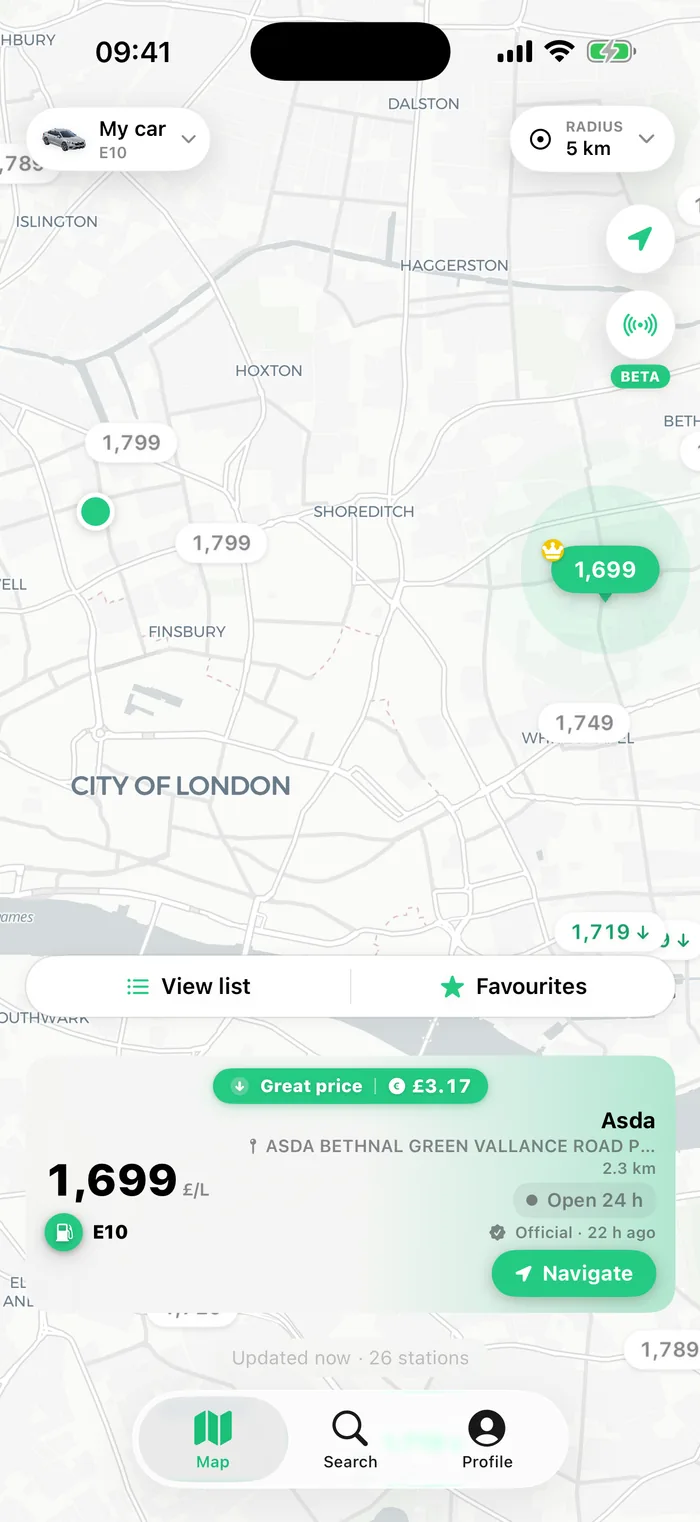
Tax is the same everywhere; the station is your choice. Refil shows you the cheapest one near you on the map, with real prices. Download it free.

 Scan with your iPhone
FAQ
How much of what I pay for petrol is tax?
In the week of 26 October 2026, 47% of the average price of petrol in the UK: 17% VAT and 30% fuel duty. For diesel, 43%.
Why does the petrol price change every week?
Because the price of fuel before tax changes: oil, the dollar against the pound and refining costs. Tax rates don't change every week. So almost all of the movement comes from the green part.
If oil falls, why doesn't my petrol fall by the same?
Because 30% of the price of petrol is fuel duty, a fixed amount per litre that doesn't fall when oil falls. And the price isn't only oil: refining, transport and the station's margin come on top and don't move in step.
Why do diesel and petrol cost different amounts?
Diesel pays less tax as a share of its price: 26% against 30% for petrol. But its fuel-and-margin part weighs more: 57% against 53%. In the week of 26 October 2026: diesel £1.992, petrol £1.741.
Is this the breakdown at my station?
No. It's the UK average. Tax is the same everywhere. What varies is the margin, which each station sets. That's why prices differ from one to the next.
How much does the station make on each litre?
We can't tell from this data. It only separates out the tax. Everything else (53%) is together: fuel, transport and margin. It isn't all profit: it also includes what the fuel cost and getting it there.
Where do I see today's price and whether it will rise?
At “Will petrol go up tomorrow?” and “Petrol prices today”. Refil updates them every day.
The same data, as a table
| Fuel | Average price | Fuel and margin | Fuel duty | VAT |
|---|---|---|---|---|
| Petrol | £1.741/L | 53% | 30% | 17% |
| Diesel | £1.992/L | 57% | 26% | 17% |
Glossary
- Brent
- The crude oil used as the reference in Europe. Its price is given in dollars per barrel. A barrel is about 159 litres.
- Refining
- The process that turns crude oil into petrol, diesel and other fuels. It happens at a refinery.
- Margin
- What a business charges over what the product cost it. It covers costs and makes a little.
- VAT
- A tax added to the price as a percentage. On fuel it is charged on the duty as well.
- Fuel duty
- A fixed amount per litre charged on fuel. It doesn't change when oil or the dollar rise or fall.
- Weekly road fuel prices
- The UK Government's (DESNZ) weekly publication of average pump prices, with the duty and VAT rates.
- Price before tax
- The fuel price before VAT and duty: fuel, transport and margin.
Sources and method
The percentages come from the UK Government's weekly road fuel prices (DESNZ): the pump price, the fuel duty rate and the VAT rate for the same week, all in pence per litre. VAT is charged on the price including duty, so we take it off first and then the duty, which DESNZ gives exactly rather than by difference; what remains is fuel and margin. These are national averages, not the price at a single station. The data doesn't split what remains across crude oil, refining and margin, and neither does this page.
Weekly road fuel prices, DESNZ (UK Government) · Data for the week of 26 October 2026.